Beyond the Brand Aura: Redefining Price Premium
In traditional commerce, a price premium is often treated as an abstract consequence of "brand aura." However, for modern e-commerce operators, a price premium is a measurable outcome engineered through visual merchandising and product presentation depth. It is the financial surplus a customer is willing to pay when the perceived value—conveyed through high-fidelity assets—exceeds the market baseline.
The Calculus of Premium: Visual ROI Analysis
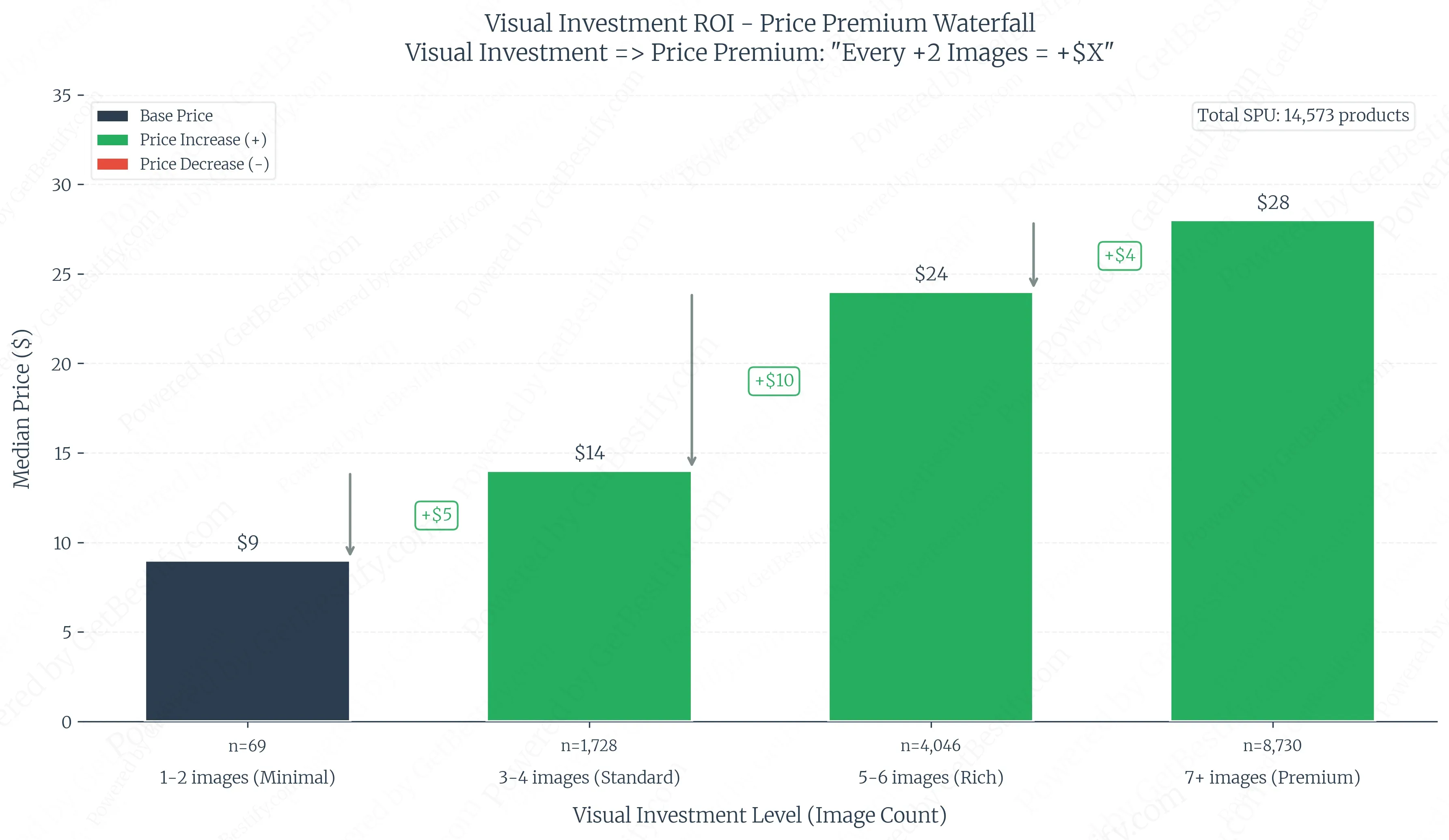
Our benchmark analysis of leading fast-fashion merchants reveals a strict, tiered logic in visual asset allocation. Price premiums do not escalate linearly; they move in distinct tiers aligned with the quantity and quality of product imagery. Data confirms that the largest price leaps occur when moving from minimal representation to "rich" presentation levels.
The Tiered Premium Effect
The baseline for a price premium begins with a minimal visual investment of 1–2 images, yielding a median price of only $9.00. The first significant leap occurs at the 3–4 image tier, where the median price rises to $14.00—a 56% premium gained simply by enriching the visual context. However, the most explosive growth is found in the 5–6 image zone, where median prices surge to $24.00, representing a 71% premium lift over the previous tier. Beyond 7 images, pricing reaches a saturation point of $28.00, indicating diminishing marginal returns on visual volume.
Strategic Resource Allocation
Top-performing brands concentrate their photography budgets where they drive the highest margin contribution. Statistics show that 95% of high-margin items reside in the 3+ image tiers. This confirms that a price premium is a self-validating cycle: high visual investment justifies high pricing, which in turn provides the capital to maintain superior production standards. Retailers who fail to align their visual assets with their pricing goals effectively "leak" revenue by under-presenting high-potential SKUs.
Executing Your Premium Strategy
To capture a price premium, e-commerce stores must shift from reactive discounting to proactive asset management. Before adjusting a price point upward, audit the visual fidelity of the listing. If you are aiming for a profit core price of $24.00, your visual presentation must meet the 5–6 image threshold to align with market-proven benchmarks of perceived value.
Access Real-World Intelligence
Understanding the mathematical relationship between presentation and pricing is the key to unlocking hidden profitability. You can access a free, condensed version of our comprehensive competitor intelligence reports, featuring deep-dives into category-level pricing and inventory health, at How This Store Makes Money. Use these real-world benchmarks to stop guessing and start engineering your brand’s pricing power.